الشفاء تلبینہ
Price range: ₨ 3,000 through ₨ 6,000
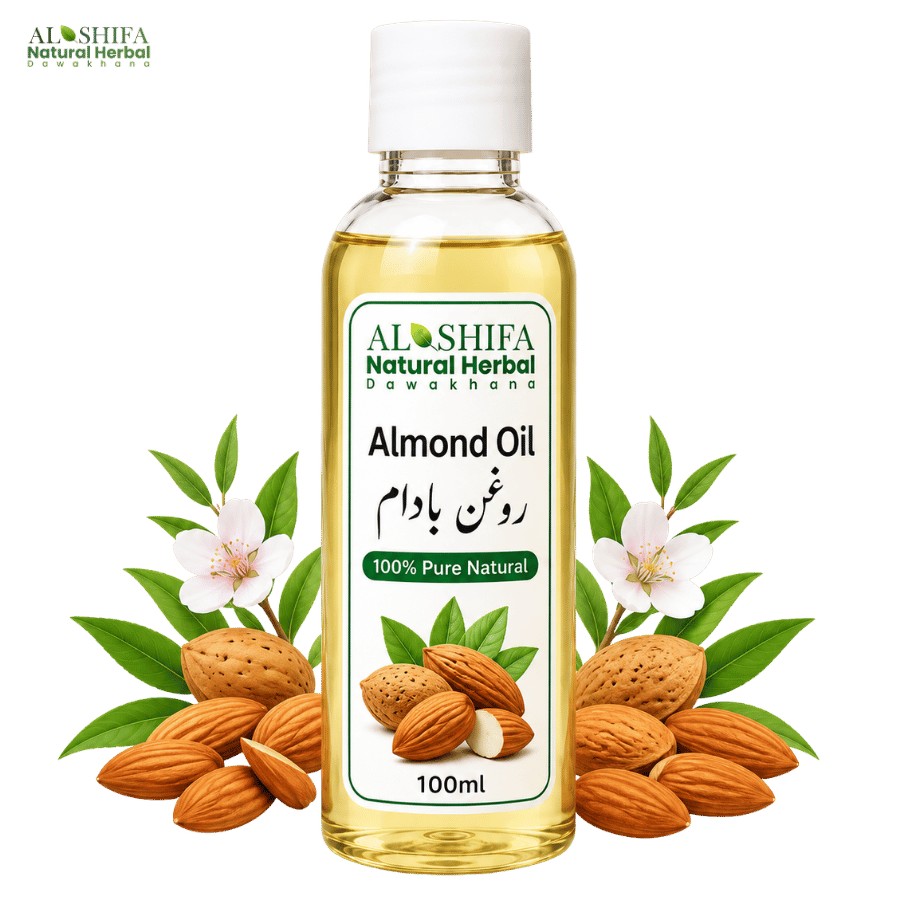
Almond Oil, commonly known as Roghan Badam. is a natural fixed oil commonly obtained from Sweet Almond (Prunus dulcis) kernels. It naturally contains oleic acid, linoleic acid and vitamin E compounds and is widely used for skin care, hair and scalp care, massage and carrier-oil preparations.
Al Shifa Almond Oil is carefully selected with attention to its almond source, natural appearance, freshness, clean handling, suitable packaging and responsible storage.
Key Features:
Usage: Apply a small amount to the skin, hair or scalp and massage gently. It may also be used as a carrier oil or in suitable cosmetic preparations. Patch test before use on sensitive skin.
Important Note: Sweet Almond Oil is a fixed/carrier oil, not an essential oil, and differs from Bitter Almond-derived products. Cosmetic-grade oil should not automatically be consumed. People with almond or tree-nut allergies should use it with appropriate caution.
Almond Oil, commonly known as Roghan Badam (روغن بادام), is a natural fixed oil obtained from almond kernels. For ordinary skin care, hair care, massage and many cosmetic preparations, the term Almond Oil most commonly refers to Sweet Almond Oil, obtained from Prunus dulcis.
Sweet Almond Oil is valued for its smooth texture, mild character and natural fatty-acid profile. It naturally contains mainly oleic acid and linoleic acid, together with smaller amounts of other fatty acids and naturally occurring vitamin E compounds.
It is widely used as a carrier oil in skin-care, hair-care, body-care, massage and cosmetic formulations. Food-grade Sweet Almond Oil may also have culinary uses, but food-grade and cosmetic-grade products should not automatically be treated as interchangeable.
An important distinction must be made between Sweet Almond Oil and Bitter Almond-derived products. They differ in raw material, composition, intended use and safety considerations.
At Al Shifa Natural Herbal Dawakhana, Almond Oil is selected with attention to its almond source, characteristic appearance, freshness, clean handling, suitable packaging and responsible storage.
Almond Oil is a natural oil obtained from the kernels of the almond tree.
The commonly used Sweet Almond is identified as:
Prunus dulcis
The almond tree belongs to the Rosaceae family, which also includes plants such as:
The oil is separated from almond kernels and may be produced using different processing methods.
Product Name: Almond Oil
English Name: Almond Oil / Sweet Almond Oil
Urdu Name: روغن بادام
Roman Name: Roghan Badam / Badam Oil
Scientific Name: Prunus dulcis (Mill.) D.A.Webb
Plant Family: Rosaceae
Plant Part: Kernel / Seed
Oil Type: Fixed Oil / Carrier Oil
Product Type: Natural Kernel Oil / Skin-Care, Hair-Care, Massage & Cosmetic Oil
This is one of the most important distinctions when discussing Almond Oil.
Sweet Almond Oil is the familiar fixed carrier oil commonly used for:
Bitter Almond-derived products require different safety considerations.
Bitter almond kernels can contain amygdalin, a cyanogenic compound capable of producing hydrogen cyanide under certain conditions.
Therefore:
Sweet Almond Oil ≠ Bitter Almond Oil
A product should not be assumed to be suitable for internal use merely because it is labelled “Almond Oil.”
Sweet Almond Oil is a fixed oil.
It does not evaporate like an essential oil and is commonly used as a carrier for diluted essential oils.
Therefore:
Sweet Almond Oil = Fixed / Carrier Oil
It should not be confused with concentrated aromatic or essential-oil-type products.
Whole almonds contain:
Almond Oil mainly contains the oil-soluble portion of the kernel.
Therefore:
Whole Almonds ≠ Almond Oil
For example, Almond Oil does not provide the same fibre or protein as eating whole almonds.
Sweet Almond Oil naturally contains a high proportion of unsaturated fatty acids.
Its main fatty acids generally include:
The exact percentages can vary according to:
Therefore:
Natural Fatty-Acid Profile ≠ Guaranteed Exact Percentage
Specific percentages require appropriate laboratory testing.
Oleic acid is generally one of the major fatty acids in Sweet Almond Oil.
It contributes to the oil’s characteristic emollient and conditioning properties.
This makes Almond Oil useful in products intended to help soften and condition skin and hair.
Almond Oil also naturally contains linoleic acid, an omega-6 fatty acid.
Linoleic acid forms part of the oil’s natural fatty-acid profile and contributes to its cosmetic usefulness.
However, the presence of beneficial fatty acids does not turn Almond Oil into a treatment for skin disease.
Sweet Almond Oil naturally contains vitamin E compounds, including tocopherols.
Vitamin E contributes to antioxidant activity within oils.
However:
Natural Vitamin E Content ≠ Guaranteed Exact Vitamin E Percentage
The actual amount depends on the oil and processing method.
Roghan Badam has a long history of use in traditional personal-care and wellness preparations.
It is commonly associated with:
Food-grade Sweet Almond Oil may also be used in selected dietary applications.
Sweet Almond Oil is widely used as an emollient in skin-care products.
It can help:
It may be used alone or incorporated into suitable cosmetic formulations.
Almond Oil forms an oily layer over the skin and helps reduce moisture loss from the surface.
This can make dry skin feel softer and smoother.
However:
Skin Conditioning ≠ Treatment for Skin Disease
Persistent severe dryness, eczema or other medical skin conditions may require appropriate diagnosis and treatment.
Sweet Almond Oil may be incorporated into facial oils and moisturising preparations.
However, individual skin responses differ.
People with:
should introduce new products carefully.
A small patch test is sensible before widespread use.
Almond Oil is frequently promoted online for under-eye dark circles.
Its emollient properties can help moisturise dry skin around the eye area.
However:
Moisturising the Under-Eye Area ≠ Proven Removal of Dark Circles
Dark circles may be influenced by:
Avoid direct contact with the eyes.
Well-moisturised skin may appear smoother and healthier.
However, Almond Oil should not be described as a guaranteed skin-whitening or pigmentation-removal treatment.
Therefore:
Skin Conditioning ≠ Skin Bleaching
Almond Oil is often used during body massage and may help keep skin soft and moisturised.
However:
Moisturising & Massage ≠ Guaranteed Stretch-Mark Removal
Existing stretch marks may not disappear simply from applying oil.
Almond Oil can condition dry skin around healed areas.
However:
Skin Conditioning ≠ Proven Scar Removal
Fresh wounds, infected skin or significant scars require appropriate care.
Sweet Almond Oil is widely used in hair-care preparations.
It can help:
It may be applied alone or blended with other suitable carrier oils.
Almond Oil is commonly associated with healthy-looking hair because of its conditioning properties.
However:
Hair Conditioning ≠ Proven Hair Regrowth
Hair loss can result from:
Persistent hair loss requires appropriate evaluation.
A small amount of Almond Oil can be used for scalp massage.
It may help soften dry-feeling scalp and provide lubrication.
However, dandruff or persistent scalp irritation can have multiple causes.
Therefore:
Scalp Moisturising ≠ Treatment for Dandruff or Scalp Disease
Sweet Almond Oil is a popular carrier oil.
Carrier oils are used to dilute concentrated essential oils before suitable external application.
Its mild texture makes it useful in:
The safe dilution of an essential oil depends on the specific essential oil and intended user.
Almond Oil provides good lubrication and is widely used in body massage.
Massage itself may support:
However:
Massage Comfort ≠ Treatment for Arthritis, Injury or Chronic Pain
Sweet Almond Oil has traditionally been used in massage preparations.
However, infant skin is sensitive.
For babies:
Children with known nut allergy require particular caution.
Cold-pressed Almond Oil is produced using mechanical extraction while limiting excessive heat during processing.
This approach may help retain more of the oil’s natural characteristics.
However:
Cold-Pressed ≠ Automatically Superior for Every Purpose
Shelf life, purity, handling and storage remain important.
Refined Almond Oil undergoes additional processing that may alter:
Refined oil can still be useful in cosmetic or other appropriate applications.
Therefore:
Cold-Pressed Oil ≠ Refined Oil
The intended use and product specification should be considered.
This distinction is important.
Cosmetic-Grade Almond Oil:
Intended for suitable external applications.
Food-Grade Almond Oil:
Produced and handled for dietary use.
Therefore:
Cosmetic Grade ≠ Automatically Food Grade
Do not consume a product merely because Almond Oil itself can have culinary applications.
The label and intended use must be checked.
Food-grade Sweet Almond Oil contains unsaturated fatty acids.
Replacing certain saturated fats with unsaturated fats can be part of an overall balanced dietary pattern.
However:
Almond Oil ≠ Treatment for Heart Disease
Health effects depend on the complete diet, quantity consumed and individual medical circumstances.
Unsaturated fats have nutritional relevance, but Almond Oil should not be presented as a medicine for high cholesterol.
People with abnormal cholesterol levels should follow appropriate dietary and medical guidance.
Roghan Badam has appeared in traditional wellness practices, but Almond Oil should not automatically be promoted as a laxative or treatment for chronic constipation.
Persistent constipation can have many causes and may require medical assessment.
Almonds are nutritious foods, but claims that Almond Oil directly improves memory or intelligence should not be treated as established medical facts.
Whole almonds and extracted oil also have different nutritional profiles.
Sweet and bitter almond materials require clear separation.
Bitter almond kernels may contain cyanogenic compounds.
Therefore, products derived from bitter almonds require appropriate processing and safety control.
Never assume that an unidentified bitter almond preparation is safe for internal use.
Almond belongs to the tree-nut group.
People with almond or tree-nut allergy should use Almond Oil cautiously.
The allergy risk can depend partly on:
Highly sensitive individuals should seek professional guidance before use.
Before applying Almond Oil widely to sensitive skin:
Patch testing does not guarantee that an allergic reaction will never occur, but it can be a useful precaution.
Normal external cosmetic use of an appropriate Sweet Almond Oil product differs from concentrated medicinal or internal use.
During pregnancy and breastfeeding:
Use only appropriately labelled products for children.
Avoid unidentified Bitter Almond Oil or concentrated aromatic preparations.
Children with known nut allergy require additional caution.
Almond can be supplied as:
Whole Almonds:
Food containing protein, fibre, fat and minerals.
Almond Powder/Flour:
Ground almond kernel.
Sweet Almond Oil:
Fixed oil separated from the kernel.
Bitter Almond-Derived Products:
Different raw material requiring additional safety consideration.
Therefore:
Whole Almond ≠ Almond Powder ≠ Sweet Almond Oil ≠ Bitter Almond Product
Like other natural fixed oils, Almond Oil can gradually oxidise when exposed to:
Oxidised oil may develop an unpleasant or rancid smell.
Proper storage helps preserve freshness and quality.
At Al Shifa Natural Herbal Dawakhana, Almond Oil is selected with attention to:
Oil Identity – Appropriate almond-derived fixed oil.
Natural Appearance – Characteristic oil colour and clarity.
Freshness – Attention to normal aroma and condition.
Clean Handling – Responsible handling during packaging.
Suitable Packaging – Packaging designed to help protect oil quality.
Responsible Storage – Protection from excessive heat, light and contamination.
Al Shifa Natural Herbal Dawakhana, established in 1999, supplies herbal oils and natural raw materials throughout Pakistan.
Our focus for Almond Oil includes:
For external use:
Apply a small amount of suitable Sweet Almond Oil to the skin, hair or scalp and massage gently.
It may also be used as:
For sensitive skin, perform a patch test first.
For internal use, only use a product specifically identified and labelled as food-grade Sweet Almond Oil and follow appropriate dietary or professional guidance.
Do not consume an unidentified cosmetic oil or Bitter Almond Oil preparation.
Almond Oil / Roghan Badam most commonly refers to Sweet Almond Oil when discussing ordinary carrier, skin-care and hair-care applications. Sweet Almond Oil and Bitter Almond-derived products must not be treated as identical.
Important distinctions include:
Store Almond Oil in a cool, dry and dark place with the bottle tightly closed.
For best quality:
Proper storage helps protect its freshness, natural fatty-acid profile and overall quality.
Almond Oil, commonly known as Roghan Badam / روغن بادام, is a natural fixed oil commonly obtained from Sweet Almond (Prunus dulcis) kernels.
It is naturally rich in unsaturated fatty acids, particularly oleic and linoleic acids, and is widely used for skin care, hair and scalp care, body massage, carrier-oil blends and cosmetic preparations.
Customers searching for Almond Oil, Sweet Almond Oil, Roghan Badam, Badam Oil, Prunus Dulcis Oil, Almond Carrier Oil, Almond Oil for skin, Almond Oil for hair, Almond Oil for face, Almond Oil for massage, Almond Oil for dry skin, Almond Oil for scalp, Almond Oil benefits, Roghan Badam benefits, Roghan Badam uses, pure Almond Oil, original Roghan Badam, Almond Oil Pakistan, Roghan Badam Pakistan, Almond Oil Lahore, Almond Oil price in Pakistan, Roghan Badam price in Pakistan, buy Almond Oil Pakistan, buy Roghan Badam Pakistan or Almond Oil online Pakistan can choose Al Shifa Natural Herbal Dawakhana for carefully selected natural oil.
Since 1999, Al Shifa Natural Herbal Dawakhana has focused on supplying herbal oils and natural raw materials with attention to product identity, freshness, clean handling, suitable packaging, responsible storage and clear product information.
Product Name: Almond Oil
English Name: Almond Oil / Sweet Almond Oil
Urdu Name: روغن بادام
Roman Name: Roghan Badam / Badam Oil
Scientific Name: Prunus dulcis (Mill.) D.A.Webb
Plant Part: Kernel / Seed
Oil Type: Fixed Oil / Carrier Oil
Product Type: Natural Kernel Oil / Skin-Care, Hair-Care, Massage & Cosmetic Oil
Traditional & General Use: Skin conditioning, hair and scalp care, body massage, carrier-oil blends and cosmetic preparations
Important Note: Sweet Almond Oil and Bitter Almond-derived products are different. Almond Oil intended for cosmetic use should not automatically be consumed, and people with almond or tree-nut allergy should use it with appropriate caution.