کوکو پاوڈر
Price range: ₨ 120 through ₨ 1,800
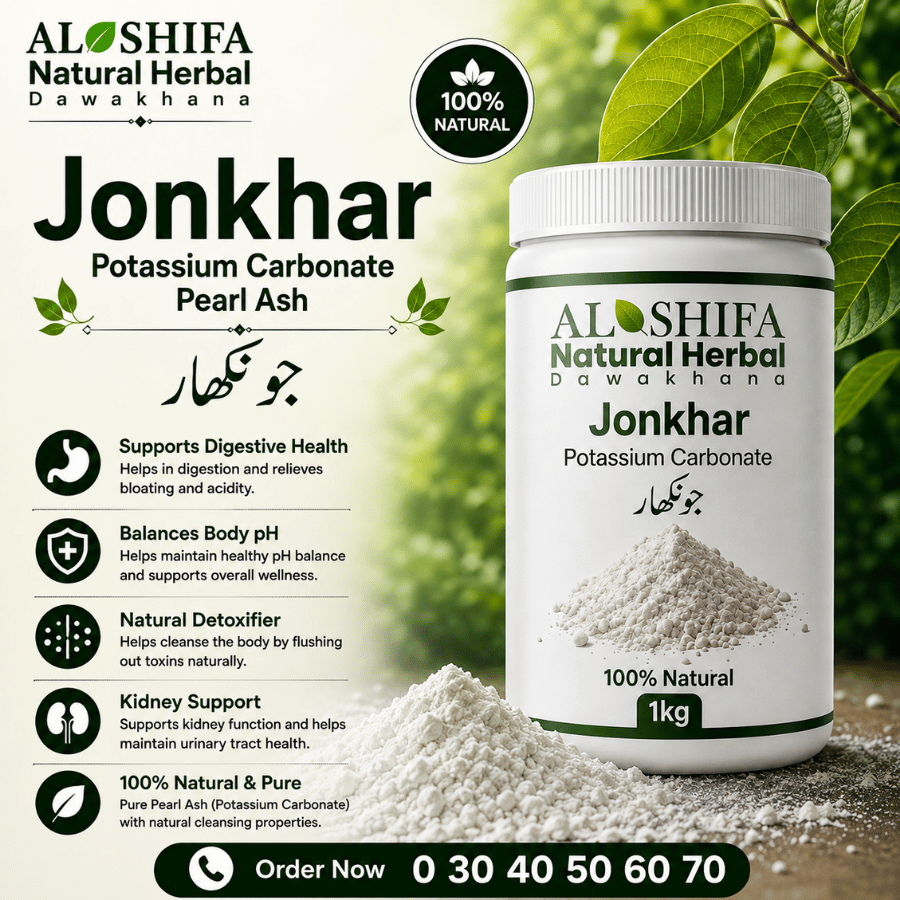
Jonkhar (Potassium Carbonate / Pearl Ash) is a traditional alkaline mineral material commonly associated with potassium carbonate, historically used in specialized Unani preparations and various processing applications.
How to Use: Use only according to its verified grade and intended purpose. Internal or medicinal use should be under qualified professional guidance.
Important Note: Jonkhar is not ordinary table salt or baking soda. Raw, industrial-grade, or unverified material should not be consumed or used as a home remedy.
Jonkhar (جونکھار) is a traditional alkaline mineral preparation commonly associated with Potassium Carbonate, an inorganic potassium salt represented chemically as K₂CO₃. In English, potassium carbonate has historically also been known as Pearl Ash or Pearlash, particularly when referring to refined alkaline material historically prepared from plant or wood ashes.
Jonkhar has a long history in traditional South Asian and Unani practice, where alkaline materials were used in specialized formulations and processing techniques. Potassium carbonate also has important modern applications in food processing, soap and glass manufacture, laboratory work, and various industrial processes. However, industrial-grade potassium carbonate must never automatically be considered food-grade or medicinal-grade.
Because traditional market names such as Jonkhar may refer to materials produced by different methods and with different levels of purity, the identity and composition of a commercial sample should ideally be verified before it is labeled specifically as pure potassium carbonate.
Jonkhar is generally encountered as a white to off-white alkaline material. Depending on its preparation, purity, moisture exposure, and storage conditions, it may occur as powder, granules, crystalline-looking particles, or irregular alkaline pieces.
Potassium carbonate is strongly alkaline and readily interacts with moisture. This property is important both for its traditional applications and for its safe handling.
Product Name: Jonkhar
English Name: Potassium Carbonate / Pearl Ash
Urdu Name: جونکھار
Roman Name: Jonkhar / Jawakhar
Chemical Identity: Potassium Carbonate
Chemical Formula: K₂CO₃
Product Type: Inorganic Alkaline Potassium Salt
General Appearance: White to off-white alkaline material
Nature: Strongly alkaline, hygroscopic material
Traditional Category: Specialized alkaline/mineral preparation
Jonkhar is a traditional name associated with an alkaline material used historically in specialized herbal, Unani, and processing practices.
When the material is specifically identified as potassium carbonate, it is chemically different from herbs, seeds, roots, gums, and natural resins. It is an inorganic salt rather than a botanical ingredient.
This distinction is important because traditional mineral and alkaline substances require different standards of identification, handling, purity assessment, and safety than ordinary dried herbs.
Potassium carbonate is an inorganic compound consisting of potassium and carbonate ions.
It is typically:
When dissolved in water, potassium carbonate produces an alkaline solution. Therefore, concentrated solutions may irritate or damage sensitive tissues.
Pearl Ash, historically written as Pearlash, is an old English term closely associated with refined potash, particularly potassium carbonate produced historically from wood ashes.
Before modern chemical manufacturing, plant and wood ashes were an important source of alkaline potassium salts.
A simplified historical process involved:
Further purification produced a cleaner alkaline product historically called pearl ash.
Modern commercial potassium carbonate, however, is generally manufactured under controlled industrial processes and should not be assumed to be identical in purity to historical ash-derived preparations.
Jonkhar should not be marketed as though it were a medicinal plant.
It has:
Its scientific identity, when verified as such, is chemical:
Potassium Carbonate – K₂CO₃
This is especially important for accurate product labeling and SEO information.
Potassium carbonate should not be confused with ordinary table salt.
Table salt consists primarily of sodium chloride, whereas Jonkhar identified as potassium carbonate is an alkaline potassium salt.
Therefore:
Potassium Carbonate ≠ Sodium Chloride
and
Jonkhar ≠ Ordinary Table Salt
Their chemistry, taste, alkalinity, applications, and safety considerations are substantially different.
Another important distinction is between potassium carbonate and baking soda.
Baking soda is sodium bicarbonate, while potassium carbonate is a different and generally more strongly alkaline compound.
Therefore:
Potassium Carbonate ≠ Baking Soda
They should not be substituted for one another in home remedies, recipes, or formulations without an appropriate technical basis.
Potassium carbonate should also be distinguished from potassium bicarbonate.
Although both contain potassium and carbonate-related ions, they are chemically different substances with different alkalinity and functional properties.
This means:
Potassium Carbonate ≠ Potassium Bicarbonate
Correct chemical identification matters whenever the product is intended for food, pharmaceutical, laboratory, or technical applications.
Historically, alkaline substances were frequently obtained from the ashes of selected plants or wood.
Ash was treated with water so that soluble alkaline salts could move into the liquid. After filtration, the alkaline solution was concentrated to obtain a crude potash-type material.
Because traditional processes were not standardized in the same way as modern chemical manufacturing, ash-derived materials could contain mixtures of:
For this reason, a traditional ash-derived product called Jonkhar should not automatically be assumed to be chemically pure potassium carbonate without appropriate verification.
Jonkhar belongs to a category of strongly alkaline substances historically used in specialized traditional formulations.
Traditional systems may have employed alkaline materials for purposes related to:
These references document traditional practice. They do not establish that raw Jonkhar is a safe or effective treatment for any disease.
Traditional literature may associate alkaline preparations with digestive complaints, acidity, heaviness, or certain gastrointestinal formulations.
However, these historical associations should not be converted into claims that potassium carbonate treats:
Potassium carbonate is a strongly alkaline chemical substance, and inappropriate ingestion can cause irritation or injury.
Persistent digestive symptoms require appropriate assessment rather than repeated self-treatment with strong alkaline materials.
One of the defining properties of potassium carbonate is its alkalinity.
When dissolved in water, it forms an alkaline solution. The strength of that alkalinity depends on concentration.
This property explains many of its:
But alkalinity also creates an important safety issue.
A substance capable of changing acidity is not automatically a safe remedy for “excess acid” in the human body.
Potassium carbonate should not be marketed as a product that “alkalizes the entire body,” “removes body acidity,” or “balances blood pH.”
The human body tightly regulates blood acidity through complex physiological systems involving the lungs, kidneys, blood buffers, and other mechanisms.
Eating or drinking a strongly alkaline substance is not a safe method of controlling blood pH.
Therefore, claims that Jonkhar can generally “make the body alkaline” should be avoided.
Potassium is an essential dietary mineral required for normal physiological functions.
However, this does not mean that raw potassium carbonate should be used as a general potassium supplement.
This distinction is important:
Potassium as an essential nutrient ≠ unrestricted use of potassium carbonate
Appropriate potassium intake normally comes from food and, when medically necessary, specifically formulated supplements or medicines.
Raw Jonkhar should not be used to correct suspected potassium deficiency without professional medical guidance.
Food-grade potassium carbonate has legitimate applications in food manufacturing.
Depending on local regulations and formulation requirements, appropriately manufactured food-grade potassium carbonate may be used as:
However, these applications involve controlled quantities and verified food-grade material.
A raw herbal-market product labeled Jonkhar should not automatically be considered suitable for food processing.
The term potassium carbonate describes chemical identity, not product quality.
Commercial potassium carbonate can be manufactured in different grades, including materials intended for:
The impurity limits and quality specifications can differ significantly.
Therefore:
Industrial Grade ≠ Food Grade
and
Chemical Identity ≠ Suitability for Consumption
A product intended for ingestion should meet the relevant food or pharmaceutical standards.
Potassium carbonate has numerous industrial applications because of its alkalinity, solubility, and chemical properties.
It may be used in:
These industrial uses should remain clearly separated from traditional medicinal use.
Industrial potassium carbonate should never be repackaged or represented as edible or medicinal material without appropriate quality verification.
Potassium compounds have historically played an important role in soap making and alkaline cleaning processes.
Potassium carbonate may be used in specialized formulations where an alkaline environment is required.
However, raw potassium carbonate is not equivalent to a finished household cleaning product.
Its alkaline nature means concentrated material can irritate:
Protective handling may therefore be necessary depending on quantity, concentration, and intended use.
Unlike many herbal products, the fundamental properties of potassium carbonate are established through chemistry rather than herbal pharmacology.
Scientific characterization focuses on properties such as:
Therefore, herbal-style claims about antioxidants, phytochemicals, flavonoids, essential oils, or plant nutrients are inappropriate for pure potassium carbonate.
If Jonkhar is verified as purified potassium carbonate, it does not naturally contain botanical active constituents such as:
These are categories associated with biological plant materials, whereas potassium carbonate is an inorganic chemical salt.
If an ash-derived traditional material contains plant-derived impurities or other mineral salts, that is a different issue and should not be presented as a beneficial standardized phytochemical profile.
Raw or technical-grade potassium carbonate should not be casually swallowed, dissolved in water for drinking, or incorporated into home remedies.
Because it is strongly alkaline, inappropriate exposure can cause irritation of the gastrointestinal tract.
Large or concentrated exposures may be more serious.
Possible symptoms following inappropriate ingestion may include:
The severity depends on the amount, concentration, formulation, and individual circumstances.
Another important consideration is potassium itself.
People with impaired kidney function may have difficulty regulating potassium levels.
Excess potassium can be dangerous, particularly for people with:
People taking medicines that can increase potassium levels should also avoid self-directed internal use.
These may include certain:
This is another reason Jonkhar should not be treated as an ordinary wellness supplement.
Dry potassium carbonate and concentrated solutions may irritate the skin, especially with prolonged exposure.
When handling larger quantities:
Traditional external use does not establish that raw potassium carbonate is safe for direct cosmetic application.
Eye contact should be avoided.
Because potassium carbonate is alkaline, powder or concentrated solution can cause significant eye irritation.
If accidental eye exposure occurs, rinse promptly with plenty of clean water and seek appropriate medical advice if irritation, pain, redness, or visual disturbance persists.
Do not intentionally use Jonkhar in or around the eyes.
Fine alkaline dust may irritate the nose, throat, and respiratory passages.
Avoid:
For bulk or industrial handling, follow the relevant workplace safety procedures.
Pregnant or breastfeeding women should not use raw Jonkhar internally as a traditional remedy without qualified medical guidance.
Food-grade potassium carbonate already present in appropriately manufactured foods is different from deliberately consuming raw alkaline material.
The distinction between normal food-processing exposure and medicinal self-use should be maintained.
Keep Jonkhar out of reach of children.
Children should not be given raw potassium carbonate as a home remedy.
Accidental ingestion or eye exposure requires appropriate attention, especially when the concentration or quantity is unknown.
High-quality potassium carbonate intended for a defined purpose should have clear information regarding:
For traditional Jonkhar, chemical verification is especially valuable because historical ash-derived alkaline products may not consist exclusively of potassium carbonate.
Traditional mineral or ash-derived products should not automatically be assumed to be free from contaminants.
Depending on raw material and manufacturing method, quality assessment may need to consider:
Claims such as “heavy-metal-free,” “food-grade,” “pharmaceutical-grade,” or “laboratory-tested” should only be made when supported by appropriate evidence.
Potassium carbonate is hygroscopic, meaning it readily absorbs moisture from the surrounding air.
If left exposed, it may:
This property makes airtight storage particularly important.
For proper storage:
Always close the container promptly after use.
The correct use of Jonkhar depends entirely on its verified composition, grade, concentration, and intended application.
For food processing, only appropriately certified food-grade potassium carbonate should be used according to a validated recipe or manufacturing specification.
For pharmaceutical or traditional medicinal applications, use only under appropriately qualified professional guidance.
For laboratory or industrial use, follow the relevant technical instructions and safety documentation.
Do not create a home medicinal dose for raw Jonkhar.
For accurate identification:
Jonkhar ≠ Ordinary Table Salt
Potassium Carbonate ≠ Baking Soda
Potassium Carbonate ≠ Potassium Bicarbonate
Potassium Carbonate ≠ Caustic Potash
Traditional Ash-Derived Jonkhar ≠ Automatically Pure Potassium Carbonate
Industrial-Grade Potassium Carbonate ≠ Food-Grade Potassium Carbonate
These distinctions are important for both product safety and accurate labeling.
Product Name: Jonkhar
English Name: Potassium Carbonate / Pearl Ash
Urdu Name: جونکھار
Roman Name: Jonkhar / Jawakhar
Chemical Identity: Potassium Carbonate
Chemical Formula: K₂CO₃
Product Category: Inorganic Alkaline Potassium Salt
Appearance: Usually white to off-white powder, granules, or alkaline material
Solubility: Soluble in water
Nature: Strongly alkaline and hygroscopic
Historical Source: Traditionally associated with refined alkaline salts obtained from plant or wood ash
Traditional Use: Specialized Unani and traditional preparations
Modern Uses: Food processing, laboratory, manufacturing, glass, soap and other technical applications depending on grade
Culinary Status: Not an ordinary culinary salt; only verified food-grade material is suitable for food applications
Storage: Airtight, cool and dry; protect from moisture
Jonkhar (جونکھار) is a traditional alkaline material commonly associated with Potassium Carbonate. However, traditional ash-derived Jonkhar may contain a mixture of inorganic salts and should not automatically be labeled as chemically pure potassium carbonate without appropriate verification.
Potassium carbonate is a strongly alkaline substance. Raw, industrial, or unverified Jonkhar should not be casually consumed, used as a potassium supplement, added to drinking water, or taken as a home remedy.
Historical Unani uses describe traditional practice and do not establish treatment for digestive, urinary, kidney, metabolic, or other medical conditions.
Only appropriately verified material should be used for its intended grade. People with kidney disease, heart conditions, electrolyte disorders, or medicines affecting potassium levels should be especially cautious about internal exposure. In case of significant accidental ingestion, eye exposure, or persistent irritation, seek appropriate medical assistance.
جونکھار ایک معروف کھاری معدنی مادہ ہے جسے پوٹاشیم کاربونیٹ اور پرل ایش کے نام سے بھی پہچانا جاتا ہے۔ دیسی حکمت، یونانی طب اور مفردات میں کھاری مادوں کی اپنی خاص اہمیت ہے۔ جونکھار اپنی کھاری خاصیت، پانی میں حل ہونے کی صلاحیت اور تیزابی مادوں کے ساتھ کیمیائی عمل کی وجہ سے معروف ہے۔
جونکھار کا تعلق ان کھاری نمکیات سے ہے جنہیں مختلف کیمیائی، صنعتی اور مخصوص طبی شعبوں میں پہچانا جاتا ہے۔ یہ مادہ پودوں کی راکھ سے حاصل ہونے والے پوٹاشیم نمکیات سے بھی وابستہ ہے۔ جونکھار کی درست پہچان اس کی کیمیائی ساخت اور خالص ہونے کی سطح سے کی جاتی ہے۔
اردو نام: جونکھار، جون کھار، پوٹاشیم کاربونیٹ
پنجابی نام: جونکھار، جون کھار
ہندی نام: یَو کھار، یَو کشار، جو کھار
فارسی نام: قلیاب، قلیا (کھاری مادوں کے عمومی نام)
عربی نام: کربونات البوتاسيوم، قلی (کھاری مادوں کے عمومی نام)
انگریزی نام: پوٹاشیم کاربونیٹ، پرل ایش
سائنسی نام: پوٹاشیم کاربونیٹ
خاندان: معدنی نمکیات، غیر نامی کاربونیٹ
اہم معلومات: جونکھار کے نام سے فروخت ہونے والے پوٹاشیم کاربونیٹ کا کیمیائی فارمولا کے ٹو سی او تھری ہے۔ آیورویدک نام یَو کھار عموما جو کی راکھ سے حاصل ہونے والے کھاری مادے کے لیے استعمال کیا جاتا ہے۔ اس کی ساخت خالص پوٹاشیم کاربونیٹ سے مختلف ہو سکتی ہے، اس لیے دونوں کی پہچان الگ ضروری ہے۔
جونکھار سفید رنگ کا کھاری مادہ ہے جو سفوف، دانوں اور باریک کرسٹل کی شکل میں ملتا ہے۔ اس کی خاص پہچان پانی میں حل ہونے کی صلاحیت اور کھاری خاصیت ہے۔
اہم خصوصیات:
قسم: کھاری معدنی نمک
رنگ: سفید یا ہلکا سفیدی مائل
شکل: سفوف، دانے یا باریک کرسٹل
خاصیت: کھاری
بنیادی جز: پوٹاشیم کاربونیٹ، جب اس کی کیمیائی پہچان یہی ہو
کیمیائی فارمولا: کے ٹو سی او تھری
پانی میں حل ہونے کی صلاحیت: اچھی
اہم استعمال: مخصوص صنعتی، غذائی اور کیمیائی شعبوں میں
جونکھار کا تعلق پودوں کی راکھ سے حاصل ہونے والے کھاری نمکیات سے بھی ہے۔ لکڑی اور دوسرے پودوں کی راکھ میں پوٹاشیم کے مختلف مرکبات موجود ہوتے ہیں جن سے پوٹاشیم کاربونیٹ حاصل کیا جاتا ہے۔
قدرتی طور پر پوٹاشیم والے نمکیات مختلف علاقوں کی مٹی، معدنی ذخائر اور پودوں میں پائے جاتے ہیں۔
پاکستان اور ہندوستان میں کھاری مادوں کے مختلف مقامی نام رائج ہیں۔ جونکھار کی اصل پہچان کے لیے اس کی قسم اور کیمیائی ساخت کو اہمیت دی جاتی ہے۔
برصغیر کی دیسی حکمت میں کھاری مادوں کو عموما گرم اور خشک خاصیت کے تحت بیان کیا جاتا ہے۔
مزاج: گرم اور خشک
جونکھار اور یَو کھار کی مختلف اقسام کے لیے مفردات میں الگ درجہ بندی ہو سکتی ہے۔ کتاب المفردات کے کسی مخصوص مستند ایڈیشن سے اس کے مزاج کے درجے کی تصدیق کے بغیر قطعی درجہ مقرر نہیں کیا گیا۔
کھاری معدنی خاصیت
تیزابی مادوں کے ساتھ کیمیائی عمل
پانی میں حل ہونے کی صلاحیت
پوٹاشیم اور کاربونیٹ کی موجودگی
دیسی حکمت میں کھاری نمکیات کی پہچان
مختلف کھاری مادوں کی درجہ بندی میں اہمیت
دیسی حکمت میں کھاری مادوں کو معدے اور ہاضمے کے حوالے سے اہمیت دی جاتی ہے۔ جونکھار کی بنیادی خاصیت تیزابی مادوں کے ساتھ کیمیائی عمل ہے۔
اس حوالے سے اہم معلومات یہ ہیں:
معدے کی تیزابیت اور کھاری نمکیات کا تعلق
ہاضمے کی ادویات میں مختلف نمکیات کی پہچان
تیزابی مادوں کے ساتھ کھاری مرکبات کا عمل
پوٹاشیم کاربونیٹ اور دوسرے کھاری نمکیات کا فرق
اہم معلومات: خالص پوٹاشیم کاربونیٹ کو معدے کی تیزابیت یا بدہضمی کے گھریلو علاج کے طور پر استعمال نہیں کیا جاتا۔ اس کی کھاری خاصیت کا مطلب یہ نہیں کہ اسے براہ راست کھانا محفوظ ہے۔
آیورویدک مفردات میں یَو کھار کو پیٹ کی گیس، اپھارے اور ہاضمے کے حوالے سے بیان کیا جاتا ہے۔
یَو کھار جو کی راکھ سے حاصل ہونے والا مخصوص کھاری مادہ ہے۔ اس کی طبی پہچان اور مقدار خالص پوٹاشیم کاربونیٹ سے الگ ہے۔
دیسی حکمت میں یَو کھار کو پیشاب کے نظام سے وابستہ ادویات کے حوالے سے بھی بیان کیا جاتا ہے۔
ان معلومات میں پیشاب کی روانی اور پیشاب کی نالی کے امراض جیسے موضوعات شامل ہیں۔ تاہم یَو کھار کے حکیمی استعمال کو خالص پوٹاشیم کاربونیٹ کا ثابت شدہ طبی فائدہ نہیں سمجھا جاتا۔
پوٹاشیم انسانی جسم کے لیے ایک ضروری معدنی عنصر ہے۔ یہ پٹھوں، اعصاب اور دل کے معمول کے کام میں اہم کردار ادا کرتا ہے۔
تاہم جسم کے لیے ضروری غذائی پوٹاشیم اور جونکھار کی شکل میں پوٹاشیم کاربونیٹ کا استعمال دو الگ چیزیں ہیں۔
جسمانی طاقت، جنسی کمزوری، مردانہ جراثیم، منی بڑھانے، عضو خاص میں سختی، مردانہ ٹائمنگ، لیکوریا، شوگر، سردرد اور کمردرد کے لیے جونکھار کے براہ راست فوائد کی تصدیق موجود نہیں۔ اس لیے ان بیماریوں کے علاجی دعوے اس کی خصوصیات میں شامل نہیں کیے گئے۔
دیسی حکمت میں جونکھار اور دوسرے کھاری نمکیات کی معلومات ان کی معدنی ساخت اور مخصوص خواص کے مطابق بیان کی جاتی ہیں۔
اہم پہلو:
کھاری نمکیات کی پہچان
پوٹاشیم والے مرکبات کی معلومات
تیزابی اور کھاری مادوں کے فرق کی سمجھ
یَو کھار اور جونکھار کی الگ شناخت
مفردات میں معدنی اجزاء کی درجہ بندی
جونکھار ایک کیمیائی معدنی نمک ہے، غذائیت سے بھرپور بیج، پھل یا جڑی بوٹی نہیں۔
خالص پوٹاشیم کاربونیٹ میں کیلوریز، پروٹین، چکنائی، کاربوہائیڈریٹس اور غذائی فائبر موجود نہیں ہوتے۔
| غذائی جز | مقدار |
|---|---|
| کیلوریز | 0 |
| پروٹین | 0 گرام |
| کاربوہائیڈریٹس | 0 گرام |
| قدرتی شکر | 0 گرام |
| کل چکنائی | 0 گرام |
| غذائی فائبر | 0 گرام |
| کولیسٹرول | 0 ملی گرام |
| پوٹاشیم | تقریباً 56.6 گرام |
| کاربونیٹ حصہ | تقریباً 43.4 گرام |
| سوڈیم | 0 گرام |
| کیلشیم | 0 گرام |
| آئرن | 0 گرام |
| میگنیشیم | 0 گرام |
| وٹامن اے | 0 |
| وٹامن سی | 0 |
| وٹامن ڈی | 0 |
| وٹامن ای | 0 |
اہم معلومات: یہ مقداریں خالص پوٹاشیم کاربونیٹ کی کیمیائی ساخت کے مطابق ہیں، غذائی استعمال کی تجویز نہیں ہیں۔ قدرتی راکھ سے حاصل ہونے والے جونکھار میں دوسرے نمکیات بھی شامل ہو سکتے ہیں۔
خالص پوٹاشیم کاربونیٹ دو بنیادی حصوں پر مشتمل ہے۔
پوٹاشیم ایک معدنی عنصر ہے جو انسانی جسم میں پٹھوں، اعصاب اور دل کے معمول کے کام کے لیے ضروری ہے۔
غذا میں پوٹاشیم کے معروف ذرائع پھل، سبزیاں، دالیں اور دوسری غذائی اشیاء ہیں۔
کاربونیٹ اس مادے کی کھاری خصوصیات کا بنیادی حصہ ہے۔ یہ تیزابی مادوں کے ساتھ کیمیائی عمل کرتا ہے۔
پودوں کی راکھ سے حاصل ہونے والے قدرتی کھاری مادوں میں دوسرے معدنی نمکیات بھی شامل ہو سکتے ہیں۔
اہم معلومات: اولیک تیزاب، لینولیک تیزاب، الفا لینولینک تیزاب اور ایروسک تیزاب قدرتی روغنوں کے اجزاء ہیں۔ یہ خالص جونکھار یا پوٹاشیم کاربونیٹ کے بنیادی اجزاء نہیں ہیں۔
جونکھار کی مقدار خوراک مقرر کرنے سے پہلے اس کی درست قسم اور طبی معیار کی پہچان ضروری ہے۔
کتاب المفردات کے کسی مخصوص مستند ایڈیشن سے خالص پوٹاشیم کاربونیٹ کی طبی مقدار خوراک کی تصدیق موجود نہیں۔ اس لیے کتاب کے نام سے کوئی غیر مصدقہ مقدار درج نہیں کی گئی۔
مقدار خوراک: خالص پوٹاشیم کاربونیٹ کے لیے خود سے اندرونی خوراک مقرر نہ کریں۔ اس کا اندرونی استعمال مستند معالج سے پوچھ کر کریں۔
غذائی معیار کا پوٹاشیم کاربونیٹ مخصوص غذائی اشیاء میں تیزابیت کو قابو کرنے اور غذائی ساخت برقرار رکھنے کے لیے استعمال کیا جاتا ہے۔
یہ استعمال مقررہ غذائی معیار اور مقدار کے مطابق ہوتا ہے۔
پوٹاشیم کاربونیٹ مختلف صفائی کی اشیاء اور صابن کی صنعت میں استعمال کیا جاتا ہے۔
پوٹاشیم کاربونیٹ شیشہ بنانے کے مخصوص صنعتی طریقوں میں بھی استعمال کیا جاتا ہے۔
جونکھار مختلف کیمیائی مرکبات اور کھاری محلول بنانے کے لیے استعمال کیا جاتا ہے۔
اچھی جونکھار کی پہچان اس کی صاف حالت، درست معدنی قسم، سفید رنگت اور یکساں ساخت سے کی جاتی ہے۔
الشفاء نیچرل ہربل دواخانہ میں درج ذیل باتوں کو اہمیت دی جاتی ہے:
جونکھار کی درست پہچان
صاف اور اچھی حالت
یکساں رنگت اور معدنی ساخت
غیر ضروری ملاوٹ سے پاک ہونے کو اہمیت
اچھی اور صاف پیکنگ
نمی اور گردوغبار سے حفاظت
معیار اور صفائی کو ترجیح
الشفاء نیچرل ہربل دواخانہ 1999 سے جڑی بوٹیوں، بیجوں اور ان سے حاصل ہونے والے روغنوں کی سپلائی کر رہا ہے۔
الشفاء میں جڑی بوٹیوں، معدنی اشیاء اور دوسرے قدرتی اجزاء کے انتخاب کے دوران درست پہچان، صاف حالت، معیار اور اچھی پیکنگ کو اہمیت دی جاتی ہے۔
جونکھار کے انتخاب میں اس کی معدنی ساخت، درست قسم اور صاف حالت اہم پہلو ہیں۔
جونکھار کو ٹھنڈی، خشک اور روشنی سے محفوظ جگہ پر کسی جار میں اچھی طرح پیک کر کے رکھیں۔
اسے نمی، پانی اور گردوغبار سے محفوظ رکھیں کیونکہ پوٹاشیم کاربونیٹ ہوا سے نمی جذب کرتا ہے۔
جونکھار ایک طاقتور کھاری مادہ ہے۔ خالص پوٹاشیم کاربونیٹ نگلنے سے منہ، گلے اور معدے کو نقصان پہنچا سکتا ہے اور جلد یا آنکھوں میں جلن پیدا کر سکتا ہے۔
اس لیے اس کی درست قسم، معیار اور مطلوبہ استعمال کی پہچان ضروری ہے۔ اندرونی استعمال مستند معالج سے پوچھ کر کریں۔
جونکھار ایک معروف کھاری معدنی مادہ ہے جس کی بنیادی پہچان پوٹاشیم کاربونیٹ کی کیمیائی ساخت، سفید رنگت اور پانی میں حل ہونے کی صلاحیت ہے۔
دیسی حکمت میں کھاری نمکیات کو ان کی مخصوص خصوصیات کے مطابق پہچانا جاتا ہے۔ جونکھار، یَو کھار اور دوسرے کھاری مادوں کی درست پہچان ان کے استعمال کو سمجھنے کے لیے اہم ہے۔
الشفاء نیچرل ہربل دواخانہ میں جونکھار کے انتخاب کے دوران صاف حالت، درست پہچان، معیار اور اچھی پیکنگ کو اہمیت دی جاتی ہے۔