روغن کلونجی
Original price was: ₨ 2,800.₨ 2,500Current price is: ₨ 2,500.
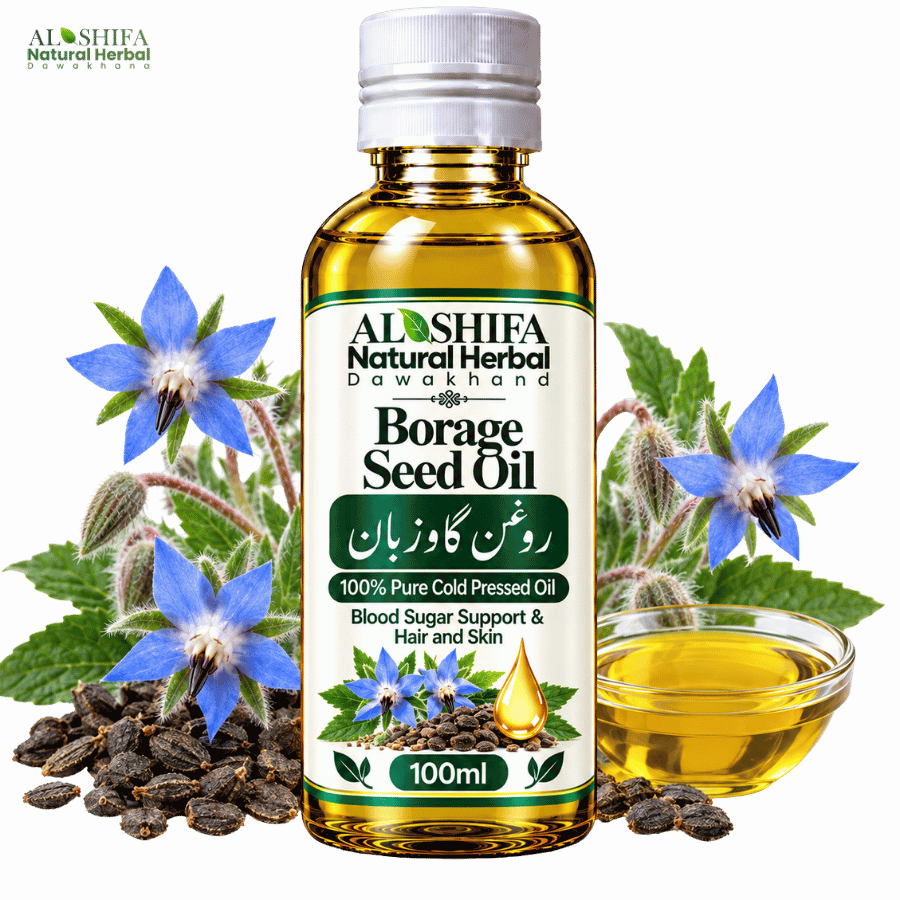
Borage Seed Oil / Roghan Gaozaban is a natural fixed vegetable oil obtained from the seeds of Borago officinalis. Naturally rich in gamma-linolenic acid (GLA) and containing linoleic, oleic and palmitic acids, it is valued for dry and sensitive-feeling skin care, facial and body care, hair and scalp conditioning, massage and cosmetic formulations.
Al Shifa Borage Seed Oil is carefully selected with attention to its correct botanical identity, characteristic fatty-acid profile, freshness, clean handling and protective packaging.
Key Features:
Usage: Apply a small amount to the skin, hair or scalp, blend with compatible carrier oils, or incorporate into suitable creams, lotions, hair oils and other cosmetic formulations.
Important Note: Borage Seed Oil is a fixed seed oil, not an essential oil or whole Borage herb. Its GLA-rich fatty-acid profile supports cosmetic skin and hair conditioning but should not be considered a treatment for eczema, inflammation, hair loss or other medical conditions. Cosmetic-grade oil should not be used internally.
Borage Seed Oil / Roghan Gaozaban – روغن گاوزبان is a natural fixed vegetable oil obtained from the seeds of Borago officinalis L., a flowering herb belonging to the Boraginaceae family. Borage Seed Oil is especially recognised for its naturally high content of gamma-linolenic acid (GLA), an Omega-6 fatty acid that distinguishes it from many commonly used carrier oils.
The oil is widely used in dry and sensitive-feeling skin care, mature-looking skin formulations, facial and body oils, massage blends, hair and scalp conditioning, creams, lotions and other cosmetic products. Its natural fatty-acid profile commonly includes linoleic acid, gamma-linolenic acid, oleic acid and palmitic acid.
At Al Shifa Natural Herbal Dawakhana, Borage Seed Oil is selected with attention to its correct botanical identity, seed-oil quality, characteristic fatty-acid profile, freshness, clean handling, protective packaging and proper storage.
Borage Seed Oil is the fixed oil extracted from the seeds of the Borage plant, Borago officinalis.
The plant produces characteristic blue, star-shaped flowers, but commercial Borage Seed Oil is obtained primarily from its seeds rather than the flowers or leaves.
The oil is particularly valued because of its naturally occurring GLA content.
It is commonly used in:
Product Name: Borage Seed Oil / Roghan Gaozaban – روغن گاوزبان
English Name: Borage Seed Oil / Borage Oil
Urdu Name: روغن گاوزبان / گاوزبان کے بیج کا تیل
Roman Name: Roghan Gaozaban / Gaozaban Oil / Borage Seed Oil
Scientific Name: Borago officinalis L.
Plant Family: Boraginaceae
Plant Part: Seeds
Oil Type: Fixed Vegetable Oil / Seed Oil / Carrier Oil
Common Forms: Cold-Pressed Borage Seed Oil / Refined Borage Oil
Appearance: Pale Yellow to Golden Yellow, Depending on Processing
Aroma: Mild, Characteristic Seed-Like Aroma
Primary Applications: Dry Skin Care, Sensitive-Feeling Skin Care, Facial Care, Body Care, Hair & Scalp Conditioning, Massage & Cosmetic Formulations
Product Type: Borage Seed Fixed Oil
Borago officinalis is an annual flowering herb traditionally known as Borage.
It is recognised by its:
The plant and its seed oil should not be treated as chemically identical products.
This distinction is important.
Borage herbal material may include leaves, flowers or aerial parts, whereas Borage Seed Oil is obtained from the seeds.
Therefore:
Borage Seed Oil ≠ Borage Flowers
Borage Seed Oil ≠ Borage Leaves
Borage Seed Oil ≠ Whole Borage Herb
Different plant parts contain different groups and concentrations of natural compounds.
The name Gaozaban / گاوزبان has a long history in traditional herbal systems of South Asia and neighbouring regions.
However, the common name “Gaozaban” can be used for more than one plant in regional herbal trade.
For Borage Seed Oil, correct botanical identification is particularly important.
This product is identified specifically as:
Borago officinalis L.
Traditional uses associated with Gaozaban herbal material should not automatically be transferred to the seed oil.
Borage Seed Oil consists mainly of natural triglycerides and fatty acids.
It is therefore a:
Fixed Vegetable Oil
It is not a conventional volatile essential oil.
Therefore:
Borage Seed Oil ≠ Borage Essential Oil
Its primary cosmetic role is as a lipid-rich conditioning and carrier oil.
Borage Seed Oil is particularly valued for its distinctive fatty-acid composition.
Important fatty acids commonly include:
The exact percentages depend on seed origin, extraction method, refining and storage.
The best-known characteristic of Borage Seed Oil is its naturally high concentration of gamma-linolenic acid (GLA).
GLA is an Omega-6 polyunsaturated fatty acid.
Borage Seed Oil is recognised as one of the richer natural botanical oil sources of GLA.
This makes it different from many ordinary carrier oils.
However:
Borage Seed Oil ≠ Pure GLA
The oil contains a complete mixture of natural fatty acids and other lipid-soluble constituents.
GLA belongs to the Omega-6 family of fatty acids.
It should not be confused with:
Therefore:
GLA ≠ ALA
and
GLA ≠ EPA or DHA
These fatty acids have different structures and biological roles.
Linoleic acid is another important Omega-6 fatty acid found naturally in Borage Seed Oil.
In cosmetic formulations, linoleic-acid-containing oils can contribute to:
However:
Linoleic Acid Content ≠ Medical Treatment for Skin Disease
Borage Seed Oil also naturally contains oleic acid.
Oleic acid contributes to:
The overall performance of Borage Seed Oil depends on its complete fatty-acid profile rather than one individual fatty acid.
Depending on extraction and refining, Borage Seed Oil can also contain smaller amounts of:
Their concentrations can vary considerably between products.
Borage Seed Oil is widely used in skin-care formulations because of its unusual fatty-acid profile.
It can contribute to:
It is particularly popular in products designed for dry or sensitive-feeling skin.
Dry skin often benefits from appropriate lipid-based emollients.
Borage Seed Oil can be incorporated into:
Its role is primarily to condition and soften the skin surface.
Because of its GLA-rich fatty-acid profile, Borage Seed Oil is frequently included in formulations marketed for sensitive-feeling skin.
However, sensitive skin has many possible causes.
Therefore:
Cosmetic Skin Conditioning ≠ Treatment for an Underlying Skin Disorder
Individual tolerance should always be considered.
Borage Seed Oil can be included in formulations for mature-looking skin because it provides lipid-rich emollient conditioning.
It can help improve:
However:
Smoother-Looking Skin ≠ Reversal of Biological Aging
Borage Seed Oil should not be presented as a product that stops or reverses the natural aging process.
Small amounts of Borage Seed Oil may be used alone or blended with compatible carrier oils in facial formulations.
Its natural fatty-acid profile makes it suitable for:
Patch testing is appropriate when introducing a new facial oil.
Borage Seed Oil is frequently discussed in relation to skin-barrier function because of its GLA and linoleic-acid content.
Fatty acids form an important part of normal skin lipids.
Topical oils can provide emollient conditioning and help reduce the dry feeling of the skin surface.
However:
Topical Borage Oil ≠ Guaranteed Correction of a Medical Skin-Barrier Disorder
Borage Oil and GLA have been studied in relation to inflammatory and dry-skin conditions, including eczema.
Research has examined different routes of administration, preparations and populations, with results that should not be simplified into a guaranteed treatment claim.
Therefore:
Borage Seed Oil Should Not Be Presented as a Proven Cure for Eczema.
People with persistent or severe eczema should follow appropriate medical care rather than relying solely on cosmetic oil.
Atopic dermatitis is a medical inflammatory skin condition.
Although GLA-rich oils have attracted research interest, evidence from one formulation or route of administration cannot automatically be applied to every cosmetic Borage Oil product.
Therefore:
Cosmetic Borage Seed Oil ≠ Medical Treatment for Atopic Dermatitis
Borage Seed Oil may appear in facial-care formulations, but acne is a complex skin condition influenced by multiple factors.
The presence of linoleic acid or GLA does not establish that the oil treats acne.
Therefore:
Borage Seed Oil ≠ Acne Medication
People with acne-prone skin should assess individual tolerance carefully.
Borage Seed Oil can be incorporated into body-care products designed to improve softness and reduce dryness.
Suitable applications include:
Borage Seed Oil can also function as a botanical hair-conditioning oil.
It can help:
Borage Seed Oil may be incorporated into scalp oils and massage blends.
Its lipid-rich nature can provide:
However:
Scalp Conditioning ≠ Treatment for Dandruff, Dermatitis or Hair-Loss Disorders
Borage Seed Oil is sometimes promoted in hair-growth formulations because of its fatty-acid composition.
However, cosmetic conditioning should not be confused with stimulation of new hair follicles.
Therefore:
Borage Seed Oil ≠ Clinically Proven Hair-Regrowth Treatment
It may improve the condition and appearance of dry hair without treating the underlying causes of hair loss.
By improving lubrication and reducing friction, an appropriate hair oil may help reduce dryness-related mechanical breakage.
This can support:
However:
Reduced Breakage ≠ New Hair Growth
Borage Seed Oil can be incorporated into massage formulations.
Because it is often used as a specialty carrier oil rather than a bulk massage base, it may be blended with compatible oils such as lighter carrier oils depending on the desired texture.
Borage Seed Oil may be incorporated into:
Borage Seed Oil and Evening Primrose Oil are frequently compared because both naturally contain GLA.
Borage Seed Oil: Borago officinalis
Evening Primrose Oil: Oenothera biennis and related Oenothera species
Both contain GLA, but their botanical origins and fatty-acid proportions differ.
Therefore:
Borage Seed Oil ≠ Evening Primrose Oil
Black Currant Seed Oil is another botanical source of GLA.
However:
Borage Seed Oil: Borago officinalis
Black Currant Seed Oil: Ribes nigrum
Their complete fatty-acid profiles are different.
Therefore:
Borage Seed Oil ≠ Black Currant Seed Oil
Flaxseed Oil is particularly known for alpha-linolenic acid (ALA), an Omega-3 fatty acid.
Borage Seed Oil is especially recognised for gamma-linolenic acid (GLA), an Omega-6 fatty acid.
Therefore:
Borage Seed Oil ≠ Flaxseed Oil
and
GLA ≠ ALA
Hemp Seed Oil generally contains substantial linoleic acid and alpha-linolenic acid, with smaller amounts of GLA depending on the oil.
Borage Seed Oil is especially valued for its comparatively high GLA content.
Therefore:
Borage Seed Oil ≠ Hemp Seed Oil
Fish oils are commonly associated with long-chain Omega-3 fatty acids such as EPA and DHA.
Borage Seed Oil is a plant-derived seed oil known for GLA.
Therefore:
Borage Seed Oil ≠ Fish Oil
GLA ≠ EPA
GLA ≠ DHA
This distinction is particularly important for safety and research interpretation.
The complete Borage plant contains compounds that are not necessarily present at the same concentrations in properly produced seed oil.
Therefore:
Borage Seed Oil ≠ Whole Borage Herb
Research or safety information about leaves and flowers should not automatically be transferred to purified seed oil without considering the actual product composition.
Plants in the Boraginaceae family can contain pyrrolizidine alkaloids (PAs) in certain plant tissues.
These compounds are important because some pyrrolizidine alkaloids can be harmful to the liver.
For Borage Seed Oil, product quality and processing matter.
Properly manufactured commercial seed oil intended for internal use should meet appropriate specifications regarding undesirable pyrrolizidine alkaloid contamination.
Therefore:
Borage Herb Safety ≠ Automatically Identical to Purified Borage Seed Oil Safety
but
Seed Oil Quality & Purity Still Matter
Borage Seed Oil is also sold in some markets as an oral supplement.
Internal use is fundamentally different from topical cosmetic use.
Before oral use, important factors include:
A cosmetic-grade product should not automatically be swallowed.
This distinction is essential.
Cosmetic-Grade Borage Seed Oil ≠ Automatically Supplement-Grade Borage Seed Oil
A product intended for topical use may not have been manufactured, tested or labelled for ingestion.
Always follow the stated product grade and intended use.
A considerable amount of interest in Borage Seed Oil comes from its GLA content.
Studies involving GLA or Borage Oil may use:
These conditions are different from ordinary topical cosmetic use.
Therefore:
GLA Research ≠ Proof that Every Borage Oil Product Treats Disease
GLA and polyunsaturated fatty acids have been studied in different metabolic and cardiovascular contexts.
However, such research should not be converted into claims that ordinary Borage Seed Oil prevents or treats:
without appropriate evidence for the exact product, dose and intended use.
GLA participates in biological fatty-acid pathways and has been studied in relation to inflammatory processes.
However:
Biochemical Activity ≠ Guaranteed Anti-Inflammatory Treatment
A cosmetic Borage Seed Oil should not be described as a replacement for medical anti-inflammatory therapy.
Internal use of Borage products during pregnancy or breastfeeding requires particular caution because product composition, pyrrolizidine alkaloid contamination and other safety factors can vary.
Cosmetic external use is different from oral supplementation, but the complete formulation should still be considered.
Pregnant or breastfeeding individuals should seek professional advice before medicinal or oral use.
Do not give cosmetic-grade Borage Seed Oil internally to children.
For topical use, choose appropriately formulated products and avoid:
Keep securely out of reach of young children.
Because pyrrolizidine alkaloids associated with Borage plant material can be hepatotoxic, internal Borage products require particular attention to purity and quality.
People with liver disease should not use Borage preparations internally without appropriate professional guidance.
People taking regular medication should obtain professional advice before using Borage Seed Oil internally as a supplement.
This is especially relevant when medical treatment involves:
Topical cosmetic use generally represents a different exposure pattern, but individual product ingredients still matter.
Although Borage Seed Oil is widely used in cosmetic formulations, individual sensitivity is possible.
Patch testing may be appropriate before wider topical use.
Discontinue use if significant:
develops.
Borage Seed Oil contains substantial amounts of polyunsaturated fatty acids.
This makes appropriate storage particularly important.
Oxidation can be accelerated by:
Oxidised oil can develop an unpleasant or rancid aroma.
Cold-pressed oil may retain more of its characteristic aroma, colour and minor compounds.
Refined oil may have:
Therefore:
Cold-Pressed Borage Oil ≠ Refined Borage Oil
The appropriate type depends on the intended formulation.
At Al Shifa Natural Herbal Dawakhana, Borage Seed Oil is selected with attention to:
Botanical Identity – Correctly identified as Borago officinalis.
Plant Part – Genuine seed-derived fixed oil.
Oil Identity – Fixed vegetable oil rather than essential oil.
Fatty-Acid Profile – Naturally rich in GLA and linoleic acid.
Skin Applications – Suitable for dry and sensitive-feeling skin formulations.
Facial Applications – Suitable for appropriately formulated facial oils and blends.
Hair Applications – Suitable for dry hair and scalp conditioning.
Cosmetic Applications – Suitable for creams, lotions, oils, balms and other formulations.
Purity Awareness – Recognition of the importance of product quality and appropriate grade.
Identity Awareness – Clear distinction from whole Borage herb and other GLA-rich oils.
Freshness – Attention to oil condition and oxidation.
Clean Handling – Carefully handled during packing.
Protective Packaging – Helps protect the oil from unnecessary environmental exposure.
Responsible Claims – No guaranteed eczema, anti-inflammatory, hair-regrowth or disease-treatment claims.
Al Shifa Natural Herbal Dawakhana, established in 1999, supplies carefully selected natural oils, herbs and botanical materials throughout Pakistan.
Our focus for Borage Seed Oil includes:
For Facial Care: Apply a small amount to clean skin or blend with compatible carrier oils after establishing individual tolerance.
For Dry Skin: Use a few drops directly where suitable or incorporate into creams, lotions, body oils and balms.
For Body Care: Blend with compatible oils or body-care formulations.
For Hair: Apply a small amount to dry lengths and ends or incorporate into a pre-wash conditioning blend.
For Scalp Care: Use in an appropriately formulated scalp oil when suitable.
For Massage: Combine with compatible carrier oils according to the desired texture.
For Cosmetic Formulations: Incorporate at an appropriate level based on the finished product requirements.
For Internal Use: Use only a product specifically manufactured and labelled for oral use and follow appropriate professional guidance.
Borage Seed Oil / Roghan Gaozaban – روغن گاوزبان is a natural fixed seed oil obtained from Borago officinalis and is particularly valued for its naturally high gamma-linolenic acid content.
Important distinctions include:
For best quality:
Borage Seed Oil / Roghan Gaozaban – روغن گاوزبان is a distinctive natural seed oil obtained from Borago officinalis. It is especially valued for its naturally high gamma-linolenic acid (GLA) content and its use in dry and sensitive-feeling skin care, facial and body oils, hair and scalp conditioning, massage blends and cosmetic formulations.
Its natural fatty-acid profile commonly includes GLA, linoleic acid, oleic acid and palmitic acid, making it different from many ordinary carrier oils.
Customers searching for Borage Seed Oil, Borage Oil, Roghan Gaozaban, Gaozaban Oil, Borago Officinalis Oil, Pure Borage Seed Oil, Natural Borage Oil, Cold Pressed Borage Oil, GLA Oil, Borage Carrier Oil, Borage Oil for Skin, Borage Oil for Dry Skin, Borage Oil for Face, Borage Oil for Hair, Borage Oil for Scalp, Borage Oil Pakistan, Roghan Gaozaban Pakistan, Borage Oil Lahore, Borage Oil price in Pakistan, Roghan Gaozaban price, buy Borage Seed Oil Pakistan or Borage Oil online Pakistan can choose Al Shifa Natural Herbal Dawakhana for carefully selected quality.
Since 1999, Al Shifa Natural Herbal Dawakhana has focused on providing natural oils and botanical materials with attention to correct identity, quality selection, freshness, clean handling, responsible product information, protective packaging and proper storage.
Product Name: Borage Seed Oil / Roghan Gaozaban – روغن گاوزبان
English Name: Borage Seed Oil / Borage Oil
Urdu Name: روغن گاوزبان / گاوزبان کے بیج کا تیل
Roman Name: Roghan Gaozaban / Gaozaban Oil / Borage Seed Oil
Scientific Name: Borago officinalis L.
Plant Family: Boraginaceae
Plant Part: Seeds
Oil Type: Fixed Vegetable Oil / Seed Oil / Carrier Oil
Common Forms: Cold-Pressed Borage Seed Oil / Refined Borage Oil
Appearance: Pale Yellow to Golden Yellow, Depending on Processing
Aroma: Mild, Characteristic Seed-Like Aroma
Primary Applications: Dry Skin Care, Sensitive-Feeling Skin Care, Facial Care, Body Care, Hair & Scalp Conditioning, Massage & Cosmetic Formulations
Product Type: Borage Seed Fixed Oil
Important Note: Borage Seed Oil is a fixed seed oil naturally rich in GLA, not an essential oil or the same product as whole Borage herb. Its fatty-acid profile makes it useful for cosmetic skin and hair conditioning, but it should not be presented as a guaranteed treatment for eczema, inflammation, hair loss or other medical conditions. Products intended for oral use require appropriate grade and purity specifications, particularly regarding pyrrolizidine alkaloids.
روغن گاوزبان بوراج کے صاف، خشک اور پکے ہوئے بیجوں سے حاصل ہونے والا قدرتی روغن ہے۔ یہ روغن خاص طور پر اپنی گاما لینولینک تیزاب کی مقدار کی وجہ سے دوسرے بہت سے بیجوں کے روغنوں سے الگ پہچانا جاتا ہے۔
اس میں لینولیک تیزاب، گاما لینولینک تیزاب، اولیک تیزاب، پالمیٹک تیزاب، سٹیئرک تیزاب اور قدرتی ٹوکوفیرولز سمیت کئی روغنی اجزا پائے جاتے ہیں۔
روغن گاوزبان کو خشک جلد، چہرے کی روغنی دیکھ بھال، ہاتھوں، پاؤں، جسمانی جلد، سر کی خشک جلد، خشک بالوں اور جسمانی مالش میں استعمال کیا جاتا ہے۔
اردو: گاوزبان، بوراج، تخم گاوزبان، روغن گاوزبان
پنجابی: گاوزبان، بوراج، گاوزبان دے بیج، گاوزبان دا تیل
ہندی: گاوزبان، بوراج، بوراج بیج، بوراج بیج کا تیل
فارسی: گاوزبان
عربی: لسان الثور
انگریزی نام: بوراج، بوراج سیڈ آئل، سٹار فلاور آئل
سائنسی نام: بوراگو آفیشینالس
خاندان: بوریجینیسی
استعمال ہونے والا حصہ: پکے ہوئے بیج
بوراج نرم پتوں والی جڑی بوٹی ہے جس کے تنے اور پتوں پر باریک روئیں ہوتے ہیں۔
اس کے پھول عموما نیلے رنگ کے اور ستارے جیسی شکل والے ہوتے ہیں۔
اسی وجہ سے اسے ستارے والے پھول کی جڑی بوٹی بھی کہا جاتا ہے۔
پھول آنے کے بعد چھوٹے بیج بنتے ہیں۔
انہی پکے ہوئے بیجوں میں قدرتی چکنائی موجود ہوتی ہے جسے دبا کر روغن گاوزبان حاصل کیا جاتا ہے۔
پاکستان، ہندوستان اور ایران میں گاوزبان کا نام ہر جگہ ایک ہی جڑی بوٹی کے لیے استعمال نہیں کیا جاتا۔
حکیمی دکانوں میں گاوزبان کے نام سے ملنے والی خشک جڑی بوٹی اور بیجوں سے حاصل ہونے والا بوراج روغن ایک ہی سائنسی قسم سے ہونا ضروری نہیں۔
بیجوں کے روغن کے لیے بوراگو آفیشینالس کی پہچان اہم ہے۔
اسی لیے روغن خریدتے وقت جڑی بوٹی کا سائنسی نام اور استعمال ہونے والا حصہ دیکھنا ضروری ہے۔
اچھے بیجوں میں یہ خصوصیات دیکھی جاتی ہیں:
بوراج کے پکے ہوئے بیج صاف اور خشک کیے جاتے ہیں۔
ان بیجوں کو دبا کر ان میں موجود قدرتی چکنائی حاصل کی جاتی ہے۔
ٹھنڈے دباؤ سے حاصل روغن میں بیجوں کے قدرتی روغنی اجزا اچھی طرح موجود رہتے ہیں۔
روغن حاصل کرنے کے بعد بیجوں کے غیر ضروری ذرات الگ کیے جاتے ہیں۔
پاکستانی اور برصغیر کی حکیمی کتب مفردات میں گاوزبان کو گرم اور تر مزاج کے ساتھ بیان کیا جاتا ہے۔
یہاں یہ فرق ذہن میں رکھنا ضروری ہے کہ حکیمی کتب میں بیان ہونے والا گاوزبان اور بازار میں بوراج سیڈ آئل کے لیے استعمال ہونے والی بوراگو آفیشینالس کی پہچان ہر جگہ ایک نہیں۔
اسی لیے جڑی بوٹی کے مزاج کو بیجوں سے حاصل روغن پر بغیر پہچان کے لاگو نہیں کرنا چاہیے۔
روغن گاوزبان کی درست پہچان اس کے بیج اور سائنسی قسم کے ساتھ کی جاتی ہے۔
گاوزبان حکمت میں معروف جڑی بوٹی ہے۔
اس کے پھول اور پتے حکیمی ادویات میں الگ استعمال رکھتے ہیں جبکہ بیجوں سے حاصل روغن اپنی قدرتی چکنائی کی وجہ سے الگ اہمیت رکھتا ہے۔
روغن گاوزبان خاص طور پر جلد اور بالوں کی روغنی دیکھ بھال میں استعمال کیا جاتا ہے۔
بیجوں کے روغن کی سب سے نمایاں خصوصیت اس میں موجود گاما لینولینک تیزاب ہے۔
روغن گاوزبان کے اہم بیرونی استعمال یہ ہیں:
روغن گاوزبان خشک جلد کی روغنی دیکھ بھال میں خاص اہمیت رکھتا ہے۔
اس میں موجود لینولیک اور گاما لینولینک تیزاب خشک جلد کو روغنی نرمی دینے کے لیے فائدہ مند ہیں۔
اس کی تھوڑی مقدار صاف جلد پر لگا کر ہلکے ہاتھ سے پھیلائی جاتی ہے۔
روغن گاوزبان چہرے کی خشک اور کھردری جلد پر کم مقدار میں استعمال کیا جاتا ہے۔
اس کے چند قطرے صاف چہرے پر لگائے جاتے ہیں۔
اسے روغن جوجوبا، روغن بادام یا دوسرے ہلکے بنیادی روغن کے ساتھ ملا کر بھی استعمال کیا جاتا ہے۔
بہت خشک جلد پر روغن گاوزبان کو دوسرے بنیادی روغنوں کے ساتھ ملا کر استعمال کیا جاتا ہے۔
اسے ہاتھوں، پاؤں، کہنیوں، گھٹنوں اور جسم کے خشک حصوں پر لگایا جاتا ہے۔
اس کی قدرتی چکنائیاں جلد کو نرم اور ملائم رکھنے کے لیے فائدہ مند ہیں۔
روغن گاوزبان خشک اور حساس جلد کی روزمرہ روغنی دیکھ بھال میں استعمال کیا جاتا ہے۔
جلد پر مسلسل سرخی، خارش یا جلدی امراض موجود ہوں تو طبی استعمال معالج سے پوچھ کر کریں۔
جلد کے امراض میں روغن گاوزبان کا طبی استعمال اپنی طرف سے نہ کریں۔
اگر جلد پر مسلسل خارش، سرخی، چھلکے یا زخم موجود ہوں تو معالج سے چیک کروائیں۔
روزمرہ خشک جلد کی روغنی دیکھ بھال اور کسی جلدی بیماری کا طبی استعمال الگ رکھیں۔
خشک ہاتھوں اور پاؤں پر روغن گاوزبان کی تھوڑی مقدار لگائی جاتی ہے۔
رات کے وقت ہلکی مالش جلد کو روغنی نرمی دینے کے لیے فائدہ مند ہے۔
خشک اور کھردری کہنیوں اور گھٹنوں پر روغن گاوزبان استعمال کیا جاتا ہے۔
اسے روغن بادام یا روغن جوجوبا کے ساتھ ملا کر بھی لگایا جاتا ہے۔
روغن گاوزبان جسمانی مالش میں استعمال کیا جاتا ہے۔
اسے اکیلا یا روغن بادام، روغن جوجوبا، روغن ناریل اور روغن زیتون کے ساتھ ملا کر لگایا جاتا ہے۔
یہ خشک جسمانی جلد کی روغنی مالش کے لیے فائدہ مند ہے۔
روغن گاوزبان سر کی خشک جلد کی روغنی دیکھ بھال میں استعمال کیا جاتا ہے۔
اسے کسی ہلکے بنیادی روغن کے ساتھ ملا کر سر کی جلد پر لگایا جاتا ہے۔
انگلیوں کے پوروں سے ہلکی مالش کی جاتی ہے۔
سر کی جلد کے امراض میں طبی استعمال معالج سے پوچھ کر کریں۔
روغن گاوزبان خشک اور کھردرے بالوں کی روغنی دیکھ بھال میں استعمال کیا جاتا ہے۔
اس کی تھوڑی مقدار بالوں کی لمبائی اور خشک سروں پر لگائی جاتی ہے۔
یہ بالوں کو روغنی نرمی اور ہمواری دینے کے لیے فائدہ مند ہے۔
بالوں کے خشک اور کھردرے سروں پر روغن گاوزبان کے چند قطرے لگائے جاتے ہیں۔
اسے روغن جوجوبا یا روغن بادام کے ساتھ ملا کر بھی استعمال کیا جاتا ہے۔
بالوں کا بہت زیادہ گرنا، مسلسل پتلا ہونا یا سر پر خالی جگہیں بننا بالوں کے امراض سے جڑا مسئلہ ہے۔
ایسی صورت میں معالج سے چیک کروائیں۔
روغن گاوزبان کو بالوں اور سر کی جلد کی روزمرہ روغنی دیکھ بھال کے لیے استعمال کیا جاتا ہے۔
روغن گاوزبان داڑھی اور اس کے نیچے کی خشک جلد پر استعمال کیا جاتا ہے۔
اسے روغن جوجوبا یا روغن بادام کے ساتھ ملا کر بھی لگایا جاتا ہے۔
چند قطرے داڑھی کو روغنی نرمی دینے کے لیے کافی رہتے ہیں۔
روغن گاوزبان ناخنوں اور ان کے اردگرد خشک جلد پر استعمال کیا جاتا ہے۔
اس کی تھوڑی مقدار لگا کر ہلکی مالش کی جاتی ہے۔
روغن گاوزبان میں اہم قدرتی روغنی اجزا یہ ہیں:
گاما لینولینک تیزاب روغن گاوزبان کی سب سے نمایاں قدرتی چکنائیوں میں شامل ہے۔
یہ اومیگا چھ خاندان سے تعلق رکھتا ہے۔
بوراج کے بیجوں کا روغن گاما لینولینک تیزاب کے معروف قدرتی ذرائع میں شمار کیا جاتا ہے۔
یہی خصوصیت روغن گاوزبان کو کئی دوسرے عام بیجوں کے روغنوں سے الگ کرتی ہے۔
لینولیک تیزاب روغن گاوزبان کی اہم قدرتی چکنائیوں میں شامل ہے۔
یہ بھی اومیگا چھ خاندان سے تعلق رکھتا ہے۔
یہ خشک جلد اور بالوں کی روغنی دیکھ بھال میں استعمال ہونے والے کئی قدرتی روغنوں میں پایا جاتا ہے۔
اولیک تیزاب اومیگا نو خاندان کی قدرتی چکنائی ہے۔
یہ روغن گاوزبان کی قدرتی روغنی ساخت کا حصہ ہے۔
پالمیٹک تیزاب بھی بوراج کے بیجوں کی قدرتی چکنائی میں پایا جاتا ہے۔
یہ کئی دوسرے بیجوں کے روغنوں میں بھی موجود ہوتا ہے۔
سٹیئرک تیزاب روغن گاوزبان میں کم مقدار میں پائی جانے والی قدرتی چکنائیوں میں شامل ہے۔
یہ بیجوں کی قدرتی روغنی ساخت کا حصہ ہے۔
روغن گاوزبان میں قدرتی ٹوکوفیرولز پائے جاتے ہیں۔
یہ وٹامن ای خاندان سے تعلق رکھنے والے قدرتی اجزا ہیں۔
بوراج کے بیجوں کے روغن میں قدرتی سٹیرولز بھی پائے جاتے ہیں۔
یہ بیجوں کے قدرتی روغنی اجزا میں شامل ہیں۔
خشک گاوزبان اور بیجوں سے حاصل روغن ایک چیز نہیں ہیں۔
خشک گاوزبان میں پھول، پتے یا جڑی بوٹی کے دوسرے حصے شامل ہو سکتے ہیں۔
روغن گاوزبان خاص طور پر پکے ہوئے بیجوں کی چکنائی سے حاصل کیا جاتا ہے۔
اس لیے خشک جڑی بوٹی کے تمام اجزا اور استعمال کو براہ راست بیجوں کے روغن کے ساتھ نہ ملائیں۔
روغن گاوزبان بیجوں سے حاصل ہونے والی قدرتی چکنائی ہے۔
جوہر گاوزبان جڑی بوٹی کے دوسرے حصوں سے تیار کیا جاتا ہے۔
دونوں کی ساخت اور استعمال الگ ہیں۔
بیجوں کے روغن کی پہچان بوراگو آفیشینالس کے بیجوں سے حاصل روغن کے طور پر واضح ہونی چاہیے۔
روغن گاوزبان اور ایوننگ پرائم روز آئل دو الگ پودوں کے بیجوں سے حاصل کیے جاتے ہیں۔
دونوں میں گاما لینولینک تیزاب پایا جاتا ہے۔
بوراج کے بیجوں کا روغن گاما لینولینک تیزاب کے بھرپور قدرتی ذرائع میں شامل ہے۔
دونوں روغنوں کو ایک ہی پودے کا روغن نہ سمجھیں۔
روغن گاوزبان کی رنگت عموما ہلکی زرد سے سنہری ہوتی ہے۔
کم صاف کیا ہوا روغن نسبتاً گہری رنگت رکھ سکتا ہے۔
بہت شوخ مصنوعی رنگ اچھے روغن کی پہچان نہیں ہے۔
خالص روغن گاوزبان میں ہلکی بیجوں جیسی قدرتی خوشبو ہوتی ہے۔
اس کی خوشبو بہت تیز نہیں ہوتی۔
باسی، سڑی ہوئی یا خراب بو روغن کے خراب ہونے کی پہچان ہے۔
روغن گاوزبان نرم اور بہنے والی روغنی ساخت رکھتا ہے۔
یہ جلد پر آسانی سے پھیل جاتا ہے۔
اسے اکیلا یا دوسرے بنیادی روغنوں کے ساتھ ملا کر استعمال کیا جاتا ہے۔
روغن گاوزبان کے چند قطرے صاف جلد پر لگائیں۔
ہلکے ہاتھ سے مالش کریں۔
بہت خشک حصوں پر ضرورت کے مطابق تھوڑی مقدار بڑھائیں۔
پہلی بار استعمال سے پہلے جلد کے چھوٹے حصے پر تھوڑی مقدار آزمائیں۔
روغن گاوزبان کی تھوڑی مقدار بالوں اور سر کی جلد پر لگائیں۔
انگلیوں کے پوروں سے ہلکی مالش کریں۔
بالوں کی لمبائی اور خشک سروں پر بھی چند قطرے لگائیں۔
بعد میں بال اپنے معمول کے مطابق دھو لیں۔
روغن گاوزبان کو درج ذیل روغنوں کے ساتھ ملا کر استعمال کیا جاتا ہے:
ان روغنوں کے ساتھ اسے چہرے، جسمانی جلد، بالوں، داڑھی اور جسمانی مالش میں استعمال کیا جاتا ہے۔
حساس جلد پر پہلی بار روغن گاوزبان کی تھوڑی مقدار آزمائیں۔
خارش، سرخی یا جلن پیدا ہو تو استعمال بند کریں۔
جلدی امراض میں طبی استعمال معالج سے پوچھ کر کریں۔
روغن گاوزبان کے نام سے فروخت ہونے والے ہر تیل کو خوراک میں استعمال نہ کریں۔
خوراک کے لیے صرف وہ روغن استعمال کریں جس پر کھانے کے قابل ہونے کی واضح ہدایت موجود ہو۔
جلد اور بالوں کے لیے تیار روغن کو نہ پئیں۔
کسی بیماری کے لیے روغن گاوزبان کا اندرونی طبی استعمال اپنی طرف سے نہ کریں۔
اندرونی طبی استعمال معالج سے پوچھ کر کریں۔
اندرونی استعمال کے لیے روغن کی خالص قسم اور معیار کی پہچان ضروری ہے۔
بوراج کے پودے کے کچھ حصوں میں ایسے قدرتی اجزا پائے جا سکتے ہیں جن کی زیادہ مقدار جگر کے لیے نقصان دہ ہے۔
اندرونی استعمال کے لیے ایسا بیجوں کا روغن منتخب کریں جس میں ان غیر ضروری اجزا کو اچھی طرح الگ کیا گیا ہو۔
جگر کے امراض میں اندرونی طبی استعمال معالج سے پوچھ کر کریں۔
اگر آپ مستقل ادویات استعمال کرتے ہیں تو روغن گاوزبان کا اندرونی طبی استعمال معالج سے پوچھ کر کریں۔
خاص طور پر خون پتلا کرنے والی یا دوروں کی بیماری کی ادویات لینے والے افراد اپنی طرف سے اندرونی استعمال نہ کریں۔
حمل کے دوران روغن گاوزبان کا اندرونی طبی استعمال اپنی طرف سے نہ کریں۔
اندرونی طبی استعمال معالج سے پوچھ کر کریں۔
بیرونی استعمال سے پہلے جلد کے چھوٹے حصے پر تھوڑی مقدار آزمائیں۔
دودھ پلانے کے دوران روغن گاوزبان کا اندرونی طبی استعمال معالج سے پوچھ کر کریں۔
بیرونی روغن کو چھاتی اور بچے کے منہ سے لگنے والی جگہ پر نہ لگائیں۔
بچوں میں کسی بیماری کے لیے روغن گاوزبان کا طبی استعمال اپنی طرف سے نہ کریں۔
طبی استعمال معالج سے پوچھ کر کریں۔
روغن کو بچوں کی پہنچ سے دور رکھیں۔
درست بیج: بوراگو آفیشینالس کے صاف، خشک اور پکے ہوئے بیج استعمال کیے گئے ہوں۔
قدرتی رنگت: ہلکی زرد سے سنہری رنگت ہو۔
قدرتی خوشبو: ہلکی بیجوں جیسی صاف خوشبو ہو۔
صاف روغن: پانی، گرد اور غیر ضروری ذرات سے پاک ہو۔
تازگی: باسی، سڑی ہوئی یا خراب بو نہ ہو۔
اصل واضح ہو: لیبل پر بیجوں سے حاصل روغن اور جڑی بوٹی کی اصل واضح ہو۔
غیر ضروری ملاوٹ سے پاک: مصنوعی رنگ، غیر ضروری مصنوعی خوشبو اور کم معیار کے دوسرے روغن کی ملاوٹ سے پاک ہو۔
روغن گاوزبان بوراج کے صاف، خشک اور پکے ہوئے بیجوں سے حاصل ہونے والا قدرتی روغن ہے۔
اس میں لینولیک تیزاب، گاما لینولینک تیزاب، اولیک تیزاب، پالمیٹک تیزاب، سٹیئرک تیزاب، قدرتی ٹوکوفیرولز اور سٹیرولز پائے جاتے ہیں۔
اس کی خاص پہچان گاما لینولینک تیزاب کی نمایاں مقدار ہے۔
اس کا بیرونی استعمال خشک جلد، چہرے، ہاتھوں، پاؤں، بالوں، سر کی خشک جلد اور جسمانی مالش میں کیا جاتا ہے۔
پاکستانی حکیمی کتب میں گاوزبان کے نام سے مختلف قریبی جڑی بوٹیاں بیان کی جاتی ہیں، اس لیے بیجوں کے روغن کے لیے بوراگو آفیشینالس کی پہچان اہم ہے۔
اندرونی استعمال کے لیے صرف صاف، معیاری اور کھانے کے درجے کا روغن استعمال کریں اور طبی استعمال معالج سے پوچھ کر کریں۔
الشفاء نیچرل ہربل دواخانہ میں روغن گاوزبان کے لیے درج ذیل باتوں کو اہمیت دی جاتی ہے:
درست بیج: صاف، خشک اور پکے ہوئے بوراج کے بیجوں کو اہمیت دی جاتی ہے۔
درست پہچان: بیجوں کے روغن کی اصل اور جڑی بوٹی کے سائنسی نام کو اہمیت دی جاتی ہے۔
قدرتی رنگت: ہلکی زرد سے سنہری قدرتی رنگت کو دیکھا جاتا ہے۔
قدرتی خوشبو: بیجوں کی اپنی ہلکی اور صاف خوشبو کو اہمیت دی جاتی ہے۔
صاف روغن: پانی، گرد اور غیر ضروری ذرات سے پاک روغن کو اہمیت دی جاتی ہے۔
تازگی: باسی یا خراب بو والے روغن سے بچا جاتا ہے۔
غیر ضروری ملاوٹ سے پاک: مصنوعی رنگ، غیر ضروری مصنوعی خوشبو اور کم معیار کے دوسرے روغن کی ملاوٹ سے پاک ہونے کو اہمیت دی جاتی ہے۔
الشفاء نیچرل ہربل دواخانہ سنہ ۱۹۹۹ سے قدرتی جڑی بوٹیوں، بیجوں اور ان سے حاصل ہونے والے روغنوں کی سپلائی کر رہا ہے۔
ہم روغن گاوزبان میں درست بیج، صاف حالت، قدرتی رنگت، قدرتی خوشبو، تازگی اور غیر ضروری ملاوٹ سے پاک ہونے کو اہمیت دیتے ہیں۔
اچھے روغن گاوزبان کی پہچان درست بیجوں، ہلکی قدرتی رنگت، صاف خوشبو، صاف حالت، تازگی اور اچھی پیکنگ سے کی جاتی ہے۔
روغن گاوزبان کو ٹھنڈی، خشک اور روشنی سے محفوظ جگہ پر کسی جار میں اچھی طرح پیک کر کے رکھیں۔
اسے تیز دھوپ، پانی اور زیادہ گرمی سے بچائیں۔
استعمال کے بعد ڈھکن اچھی طرح بند کریں۔
روغن گاوزبان قدرتی غیر سیر شدہ چکنائیوں سے بھرپور ہوتا ہے، اس لیے اسے زیادہ گرمی اور مسلسل ہوا لگنے سے بچائیں۔
اگر روغن میں باسی یا خراب بو پیدا ہو جائے تو استعمال نہ کریں۔
اسے بچوں کی پہنچ سے دور رکھیں۔
روغن گاوزبان خریدتے وقت اس کی سائنسی پہچان اور بیجوں سے حاصل ہونے کی وضاحت ضرور دیکھیں۔
پہلی بار جلد کے چھوٹے حصے پر تھوڑی مقدار آزمائیں۔
آنکھوں اور کھلے زخموں پر نہ لگائیں۔
خارش، سرخی یا جلن پیدا ہو تو استعمال بند کریں۔
جلد اور بالوں کے لیے تیار روغن کو نہ پئیں۔
اندرونی استعمال کے لیے صاف اور کھانے کے درجے کا روغن منتخب کریں۔
حمل، دودھ پلانے، جگر کے امراض یا مستقل ادویات کے ساتھ اندرونی طبی استعمال معالج سے پوچھ کر کریں۔
روغن گاوزبان بوراج کے پکے ہوئے بیجوں کی قدرتی چکنائی سے حاصل کیا جانے والا روغن ہے۔
پاکستانی اور برصغیر کی حکیمی کتب مفردات میں گاوزبان کو گرم اور تر مزاج کے ساتھ بیان کیا جاتا ہے، لیکن گاوزبان کے نام سے مختلف جڑی بوٹیوں کی پہچان پائی جاتی ہے، اس لیے بوراج کے بیجوں کے روغن کی سائنسی پہچان الگ رکھنا ضروری ہے۔
اس میں لینولیک تیزاب، گاما لینولینک تیزاب، اولیک تیزاب، پالمیٹک تیزاب، سٹیئرک تیزاب، قدرتی ٹوکوفیرولز اور سٹیرولز پائے جاتے ہیں۔
اسے خشک جلد، چہرے، ہاتھوں، پاؤں، بالوں، سر کی خشک جلد، داڑھی اور جسمانی مالش کے لیے استعمال کیا جاتا ہے۔
گاما لینولینک تیزاب کی نمایاں مقدار روغن گاوزبان کی خاص پہچان ہے۔
اچھے روغن گاوزبان کی پہچان درست بیج، قدرتی رنگت، ہلکی بیجوں جیسی خوشبو، صاف حالت، تازگی اور غیر ضروری ملاوٹ سے پاک ہونے سے کی جاتی ہے۔